Data note: Witchspire entered Steam Early Access on June 10, 2026 and is still in active development (community sources reference roughly patch 0.1.4). The details in this Witchspire beginner guide come from community-reported data — fan wikis, guide hubs, and player-written Steam guides — rather than official documentation. Spawn locations, recipes, and drop tables are patch-dependent and are not officially confirmed. Treat exact numbers as a starting point to verify in your own save.
So you have washed up in Thornveil, you have a wand in hand and no idea what matters first. This getting-started walkthrough is ordered by impact — the decisions and crafts that snowball through your first ten hours of Witchspire — so you spend your early time on things that actually carry forward instead of chasing shiny distractions.
Choosing Your Starter Familiar Is Your First Real Decision
The single biggest early-game choice in Witchspire is your starter Familiar. Community guides converge on two safe picks, with two more for players who want a specific playstyle.
- Quol (Ethereal) — widely regarded as the safest, most beginner-friendly starter, and the default solo pick. If you are unsure, take Quol and stop overthinking it.
- Locto (Lux) — a support Familiar that shines in co-op, healing and enabling your group rather than carrying damage alone.
- Fien (Nox) — tuned for aggressive ranged combat and enemy control. Great once you are comfortable with combat timing, less forgiving before that.
- Bril (Crystal) — a defensive starter summoned during the daytime via a sundial (more on that quirk below).
If you plan to play with friends, Locto’s support kit is the community’s co-op recommendation; solo players should default to Quol.

Build and Upgrade the Hearth Before Anything Else
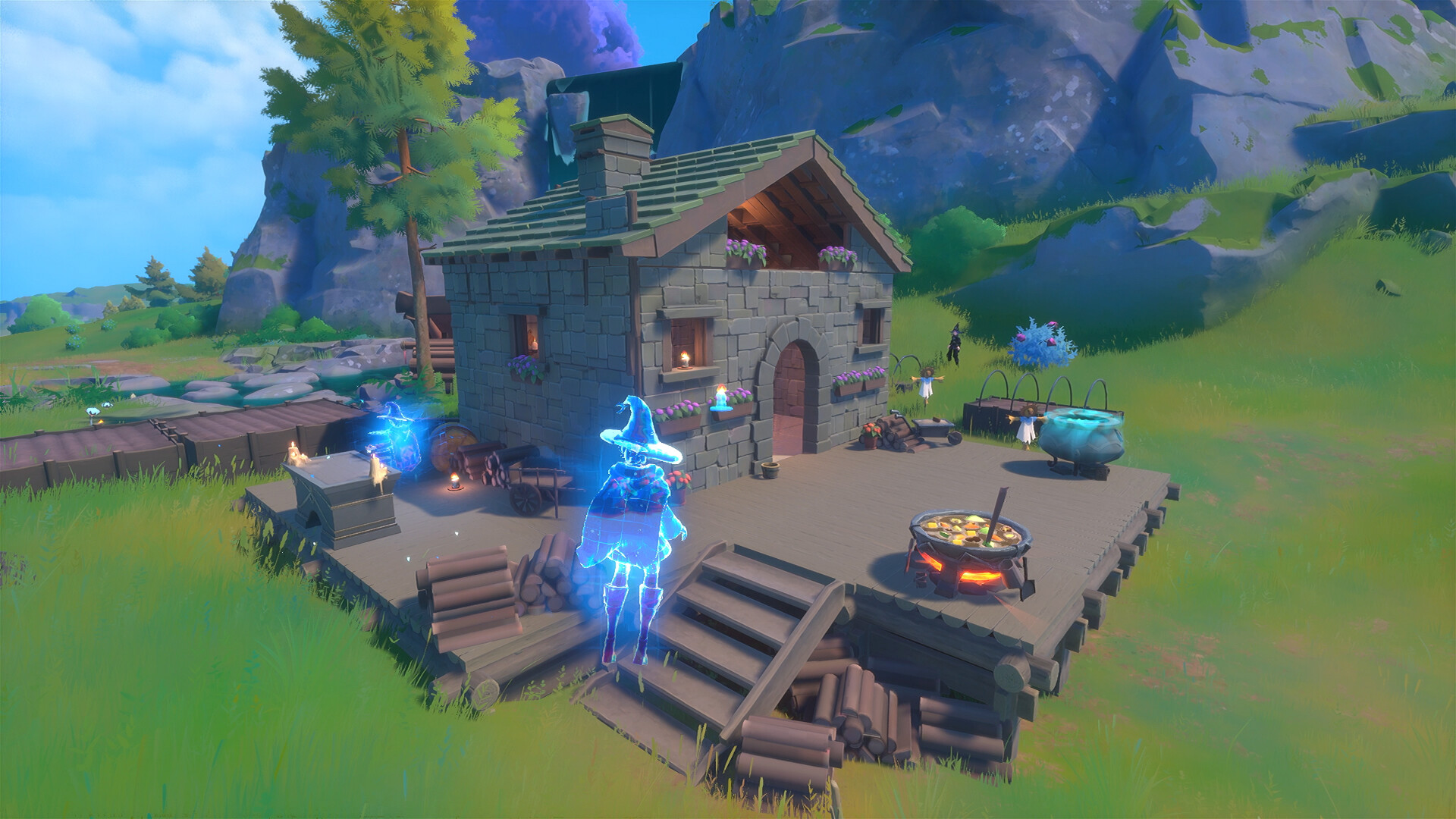
The Hearth is the heart of your base. It prevents enemies from spawning nearby, doubles as your fast-travel anchor, and upgrades through nine levels. Practically every community beginner guide repeats the same instruction: get the Hearth up before you wander.
The critical early recipe is the Hearth Core, the item that upgrades the Hearth to Level 2 and is described by community sources as the single most important early craft. Nearby related materials include Spirit Essence (used to craft the Hearth Core), Planks (listed as part of the Hearth Level 1 → 2 upgrade), and Crystal (needed for a Hearth Core upgrade). Later Hearth levels scale up: the Level 7 upgrade calls for a Ritual Candle crafted at the Alchemy Circle, while a Windmill unlocked at Hearth level 7 leads into the level 8 upgrade, which in turn unlocks the Forester’s Hut.
Your crafting stations ramp up alongside the Hearth:
- Workbench and Alchemy Table — available from the very start (tools, familiar whistle, bait, and lantern; potions, elixirs, Hearth upgrades, and incense).
- Forge — unlocked through Meadows exploration; enables metal tools and the tier 2 pickaxe.
- Spell Weaving Loom — unlocked in Mid Meadows for scrolls, robes, and tome weapons.
- Alchemy Circle — unlocked from the central skill tree for ritual candles.
- Furnace — smelts ore into ingots using charcoal.
- Windmill, Forester’s Hut, and Mining Station — mid-game structures tied to passive production.
Surviving Your First Night
Night changes the map. Several Familiars only spawn after dusk, and the world gets noticeably less friendly. The community’s core pre-night checklist is short:
- Craft a Witch’s Lantern before the first night. This is called out in nearly every beginner guide.
- Stock a Health Elixir, the most accessible early healing item, crafted from Moonleaf and Spring Water.
- Keep a Mana Elixir on hand if your build leans on spells.
- Carry Purification Dust to cleanse corruption when you start pushing into tougher biomes.
Witchspire Quest Guide: The Opening Main Quest
The early Main Quest is linear enough to follow, but two quirks trip up first-time players. First, Timberline Basin is explored early in the Main Quest before you reach the Froblin Camp in Eastell (part of the Mira Isles). Second — and this is the important part — some quest Familiars live in areas you likely will not return to.
Peb is described by community sources as an early quest mob (linked to the “Queen of the Rocklings” achievement), and Vex, a Quol-species Familiar, sits in a cave behind a waterfall during an early quest. The problem: at that point you probably have no Incense, and the community reports that bonding a Familiar without incense is practically nil in success chance. Since these are one-time-feeling areas, the habit that saves you a lot of backtracking is crafting Incense as soon as you can and returning prepared.
Later in the quest line, Verlai appears only at night, and is eventually replaced by Cindle. If you are hunting either, know which one your save is currently on.
Witchspire Familiar Guide: Catching, Rarity, and Timing
Incense is the main catching tool for raising bonding success with wild Familiars. Tiers include Simple Spirit Incense (Spirit Dust), Incense of Calling (requires a Spirit Shard), and Shimmering Incense (Greater Spirit Dust plus Shimmer Dust). Build a stockpile early — you will burn through it.
Rarity is tracked through bonding achievements, which is the clearest signal of how the system works:
- 1 star — Rare (“A Rare Find”)
- 2 stars — Epic (“Epic moment”)
- 3 stars — Legendary (“Strongest around”)
Two special variants overlay those tiers. A Celestial Familiar glows slightly and is tied to a dedicated achievement; a Shifty Familiar differs from the norm by color — the community example being a purple Rockling versus the standard green one.
Timing and placement matter enormously. Here is what community sources report:
- Fien and Firra spawn near Mirella’s cabin at the start of night and linger until shortly after morning. Firra can also appear in a more hidden corner near the cabin or on a nearby hill with wand towers.
- Verlai follows the same night-only window.
- Bril is summoned only during the day by stepping on a sundial button when the shadow aligns with the pointer. Only one Bril can be summoned at a time, so have a strong wand and scrolls ready if you are farming a 3-star. Note: one community player reported that after patch 0.1.4 the timing shifted and they had to press the button when the shadow sat at roughly a 120-degree angle before reaching the pointer — if the standard alignment fails, try that.
- Etherit respawns normally, day and night, making it one of the easier targets to practice on.
- Gwaraofeerinax has two reported spawn locations: a level 20/22 open-air high point and a level 30/32 spot inside a cave.
- Traxio (dragon-like, level ~28/30) appears near one of Mirella’s stalls and at a second, more isolated point.
If you are stuck on a boss, the community pairs specific Familiars to specific fights: Wildroot and Starsmith for the Aloonian Golem, Cloudpiercer and Tomekeeper for the Shudder Matriarch, and Cloudpiercer with Foreteller for the Sand Wraith.
Witchspire Farming Guide: Gold and Materials That Matter
Gemstones are the community’s best gold-per-hour item, selling for 25 Gold each — and crucially, Mirella’s Shop buys Gemstones at full price, so there is no reason to sell them anywhere else. You can scale this into passive income with a Mining Station that produces Gemstones automatically once a Familiar is assigned to it. The Forester’s Hut (Hearth level 8) does the same job for Beeswax or Wood with an assigned Treetop.
The other material routes worth knowing early:
- Wood comes from branches and small trees; Premium Wood from larger trees.
- Charcoal comes from burning wood or chopping flaming trees — the Ink Crater (Inky Vent) is a noted source, alongside copper ore.
- Iron Ore is mined from nodes in the Meadows.
- Ingots (Copper, Iron, Gold, Silver) are smelted in the Furnace using charcoal. Gold Ingot is a late Early Access material, and Silver Ingot is location-specific (a Mira Isles Flight Pillar sits near a silver ore route).
- Beeswax drops from Froblins and the R’hyrrgar boss; the Froblin Camp in Eastell is a farm spot, and community reports also place Beeswax drops beyond Vyr’s Landing.
- Horn and Rich Spirit Pollen drop from the large horned ram.
- Spirit Shard feeds the Staff of Echoes (crafted at the Spell Weaving Loom) and the Incense of Calling.
One more community-reported farming item worth watching for: a luck-charm trinket described by players as the Luck Clover. It reportedly boosts legendary drops from chests, is found on the starting island, and has a ~2 hour real-world respawn (the world must stay open). Reported spawn spots are the very tip of a mountain peak and the middle of a group of five stones on another mountain. Not officially confirmed — verify before relying on it.

Coven and Skill Tree Basics
At Thornveil Academy you are offered six Coven choices, and one of them — The Nightscribes — is described as a highly revered, mysterious, ambitious Coven attuned to the stars and the darkness of night. Coven selection feeds into coven-specific bonuses and a branching tech tree, so it is worth reading the options rather than clicking through.
Your growth outside Coven identity runs on Luminary Points spent in the Luminary Skill Tree. Three nodes community players repeatedly highlight:
- Vigor — enables the double jump, which changes how you traverse the vertical world.
- Luck — increases your Luck stat by 1 per point, which pairs naturally with a Gemstone-funded farm loop.
- Scroll of Regrowth — both a scroll and a Luminary node; using it spawns Spirit Trees, a renewable source of Spirit Wood.
The community’s blunt version of the skill-tree advice: upgrade the Hearth and the Luminary tree to unlock the broom. Flight transforms travel, and it is gated behind that progression rather than currency.
Boss Progression for Beginners
You do not have to fight bosses to enjoy the early game, but each one gates useful rewards. Roughly in order of accessibility:
- Aloonian Golem — a rock-and-Nature boss in the Meadows / Vyrs area and the most accessible starting boss. Bring Wildroot (Nature) and Starsmith (Crystal).
- R’hyrrgar — found near the Froblin Camp and drops Beeswax, making it a farm target as much as a fight.
- Shudder Matriarch — a Nox-aligned boss in the Shuddersands desert that uses corruption attacks and summons minions. Cloudpiercer (Ethereal) and Tomekeeper (Lux) are the community recommendations.
- Sand Wraith — an Ethereal-aligned boss that haunts the Shuddersands with hit-and-run attacks; Cloudpiercer and Foreteller (Astral) are suggested.
- Moonlit Guardian — an Early Access, unverified boss associated with the Moonlit Grove. Community sources tie the Grand Coven Robes (high magic-resistance) recipe to the Moonlit Grove boss: unconfirmed.
Quick Beginner Checklist
If you only remember five things from this Witchspire guide:
- Pick Quol (solo) or Locto (co-op) as your starter Familiar.
- Gather everything — most beginner sticking points are missing materials, not missing skill.
- Build the Hearth early and treat it as your respawn and fast-travel anchor.
- Craft a Witch’s Lantern before the first night.
- Push the Hearth and Luminary tree to unlock the broom, and run Gemstone mining sold at Mirella’s Shop for gold.
Because Witchspire is in Early Access, expect the endgame (including the Spire’s four-keys system) to remain incomplete and subject to change — and re-verify any community-reported spawn or recipe against your current patch.